MOTS-c Research Overview
An overview of MOTS-c, a mitochondrial-derived peptide, and its role in metabolic research.
Scientific background / literature overview only. Discussion of published research does not describe the intended use of Novex Peptide products.
Introduction
> **Research Context Notice** — This article summarises published scientific literature for educational and research-reference purposes only. Discussion of experimental, preclinical or clinical findings does not represent a permitted use of Novex Peptide products. Products supplied by Novex Peptide are intended exclusively for in-vitro laboratory research and are not intended for human or animal administration.
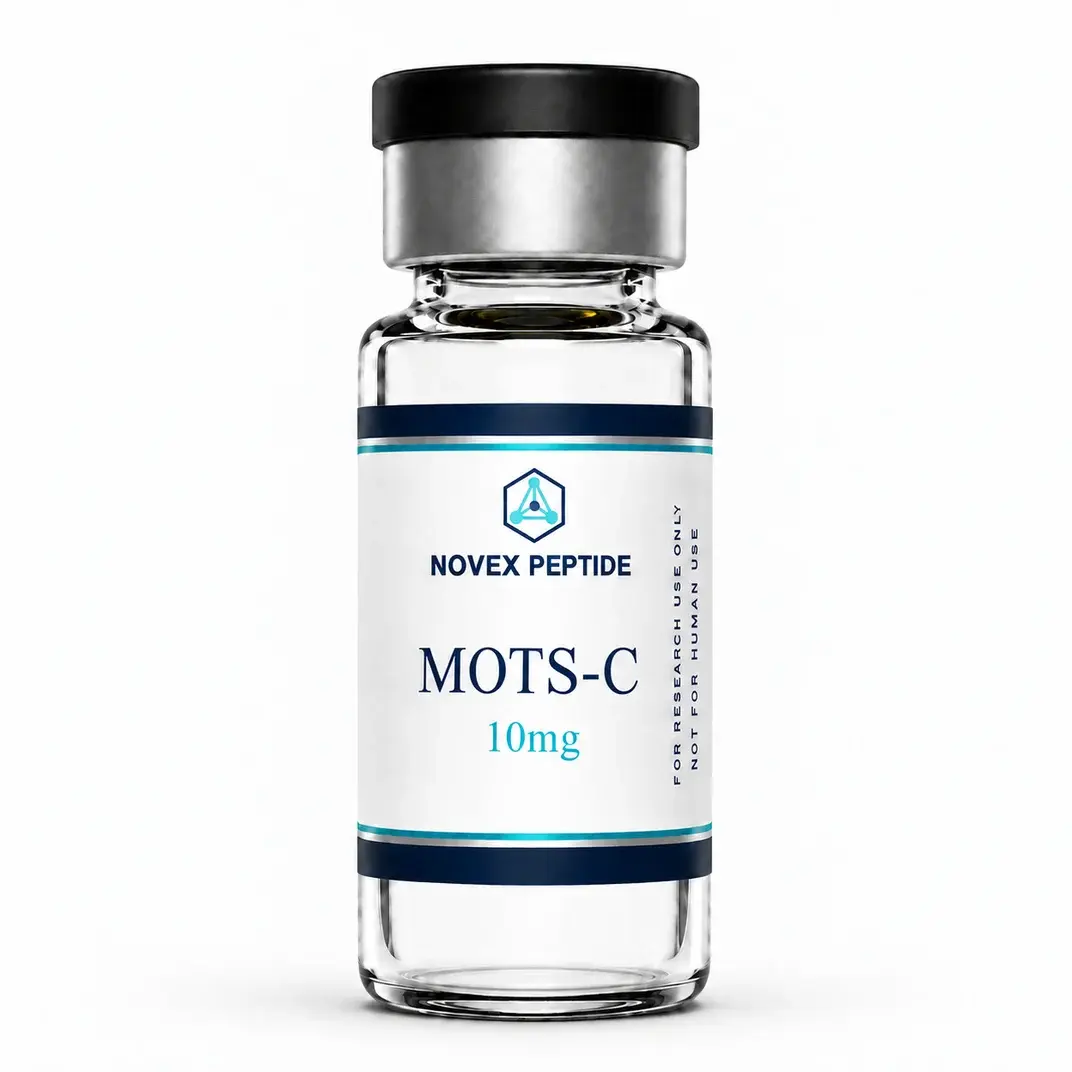
MOTS-c (Mitochondrial Open Reading Frame of the 12S rRNA Type-c) is a 16-amino acid peptide encoded within the mitochondrial genome. Discovered in 2015, it is one of a class of mitochondrial-derived peptides (MDPs) that have become a focus of metabolic research.
Mechanism of Action
MOTS-c acts through several pathways:
AMPK Activation
Research indicates MOTS-c activates AMP-activated protein kinase (AMPK), a key cellular energy sensor that regulates glucose and lipid metabolism.
Folate Metabolism
MOTS-c has been shown to influence the folate-methionine cycle, potentially affecting one-carbon metabolism and cellular energy homeostasis.
Mitochondrial Function
As a mitochondrially encoded peptide, MOTS-c may play a role in regulating mitochondrial biogenesis and oxidative phosphorylation.
Current Research
Metabolic Research
Animal studies have investigated MOTS-c's effects on glucose tolerance, insulin sensitivity, and obesity prevention in high-fat diet models.
Exercise Research
Research has explored MOTS-c's role in exercise adaptation, including its effects on skeletal muscle metabolism and physical performance in animal models.
Ageing Research
Some studies have investigated MOTS-c levels in relation to ageing and age-related metabolic decline, though this research is preliminary.
Chemical Properties
Reference values describe the named molecular form in [PubChem](https://pubchem.ncbi.nlm.nih.gov/compound/146675088). Salt, counterion, hydration and formulation may change the mass of supplied material. Confirm the supplied form before quantitative use.
Storage Considerations
Follow the supported product label and compound-specific laboratory protocol. Solution stability depends on the exact material, solvent, concentration and storage conditions; there is no universal refrigerated shelf life or freezing protocol. Obtain missing stability information before preparation. Where validated, use aliquots to minimise repeated freeze-thaw cycles.
Testing Methods
MOTS-c batches should be verified by:
Research Limitations
MOTS-c is supplied for in vitro laboratory research only. Most published research is from animal models. No clinical trials have confirmed efficacy in humans. No medical, therapeutic, or dosing claims are made. MOTS-c is not approved for human therapeutic use by any regulatory authority.
References
- 1.Lee C, et al. The Mitochondrial-Derived Peptide MOTS-c. Cell Metab. 2015;21(3):443-454.
- 2.Lee C, et al. MOTS-c and Metabolic Homeostasis. FASEB J. 2019;33(4):5525-5533.
- 3.Kim KH, et al. Mitochondrial-Derived Peptides. Exp Biol Med. 2018;243(2):170-176.
Research use only. This article is for educational purposes only and does not constitute advice for any application involving human use. No medical claims are made.